Tuesday, September 2, 2008

Hocking Hills Graffiti


New and old graffiti at Rock House, Hocking Hills State Park.

I've visited a lot of caves and rock formations and almost always, I've found graffiti in these places. I found numerous examples at Hocking Hills over the weekend.

One interesting thing I've noticed is that many tour guides will point out old graffiti, usually from the 1800's, but will also ask that people refrain from adding to it. While this is totally understandable, I think it's worth noting that the only difference between the grafitti pointed out by tour guides and that discouraged by them is age.

Carving into rocks destroys them over time, but the carvings also serve as a sort of ledger or log. You can see who was where and when, and sometimes even what they were doing. Teens who carved names and dates into Rock House in 1890 probably did not get into trouble since those areas were not protected at that time; teens who do the same in 1990 could have been kicked out of the park or worse.

My question is, how much time must pass before we regard carved graffiti as historic rather than with disdain? I saw some from the 1980's and it seemed to mar the rock surface, but another inscription from 1809 fascinated me. Is the difference that the features of Hocking Hills were once just part of a larger wilderness, something that was expendable since so much of the country was still uninhabited? Is it that old human instinct to mark something not everyone could find? Now that we have fewer and fewer of these beauty spots to visit, they become more valuable and there isn't the need to claim where you have been, since so many have been there before. Perhaps that instinct to commemorate a visit still lingers, even when it no longer means anything.

Moonville Tunnel


My husband and I spent Labor Day weekend with friends in a cabin near Hocking Hills. We headed out Sunday to hand-feed hummingbirds at Lake Hope State Park, where I happened to pick up a historical tour brochure and discovered that the Moonville Tunnel was on park property. On one of my many visits to the Forgotten Ohio site, this story caught my eye and I made a mental note to visit one day. Because I have planned many trips to weird spots, it was funny to happen upon this local gem by accident.

I always assumed the Moonville Tunnel was something you weren't encouraged to visit and thought it was on private property. Much to the contrary, the park maintains a road and trail and a forest ranger keeps an eye on things since copperheads abound and there are plenty of places for people to get hurt if they aren't careful.

The most awesome park ranger I've ever met acted as a gatekeeper, giving us the choice between a creek crossing and a poison ivy-riddled path that would surely end in days of itching. We chose wet feet.


The remaining trestles:


The creek crossing:


While the tunnel is supposed to be haunted by a drunkard who fell on the tracks one night and was killed, we saw no signs of ghosts. We did, however, see plenty of messages left by visitors past. This one says "Stabby the hobo".


One of the more sinister pieces:


All in all, this was a pretty cool side trip. It would be great to go back at night, but judging from some of the art, I'm not sure how many of these folks I'd like to run into. The frightful effect would be heightened by the fact that this is in the middle of nowhere. If you're ever in the area, stop by. Just be sure to watch out for copperheads!

Thursday, August 28, 2008

Jennie Wade


During a trip to Gettysburg a few years ago, we made a stop at the Jennie Wade House for a tour. We knew very little about Jennie's story going in, but what I learned about her and her family while we were there has stuck with me.

While I am sure Jennie's story has been romanticized and elaborated over the years, there are many elements of truth that provide an interesting look into the experience of civilians during the Civil War.

Jennie, whose full name was Mary Virginia "Jennie" Wade, was born on May 21, 1843 in Gettysburg, Pennsylvania.

At age twenty, she found herself in the middle of the Battle of Gettysburg. Ginnie and her mother traveled to sister Georgia's home to help with her newborn baby. Like many women of the time, they tried to help the Union soldiers by baking bread. On July 3, 1863, as Ginnie stood kneading dough, a single bullet passed through the door, fatally wounding her. She died instantly and her body was taken to the cellar where it remained until she was buried in her sister’s garden. In 1865, her body was interred at her final resting place in Evergreen Cemetery, where a large monument now stands. To this day, people still leave flowers on her grave.

Sadly, her fiancé, Jack Skelly, died of his wounds from a battle two weeks earlier without knowing Ginnie’s fate. He is buried near her in the cemetery.

This story and the Jennie Wade house are rich with symbols of the horrors of war.

This photo is of the hole supposedly made by the minié ball that killed Jennie Wade. There seems to be a lot of doubt about its authenticity since a man who once owned it admitted to enlarging it for effect. In addition, almost inexplicably, this hole has become a symbol of love. According to legend, a woman who pokes her finger through the whole will be betrothed soon. I'm not sure how this began, but it seems rather morbid considering the circumstances.


This is the statue of Georgia, Jennie's sister, who had the grim task of digging her sister's grave. I can't imaging just have given birth and then having to do this. She was burying her sister when many women would still be recovering from childbirth.


Jennie Wade's monument. A monument of this size seems to have been rare for a young woman; it is a testament to her symbolic acts and status as a hero and martyr for the Union cause. The elaborateness of her memorial and the flowers left on her grave today show the romanticism with which she is now regarded.

Saturday, August 16, 2008

Old Jewish Cemetery, Cincinnati, Ohio


After a few people at work asked me about my blog, I invited them along on a lunchtime trip to find Cincinnati's Old Jewish Cemetery. There isn't a lot of readily available information to be found online, and I was not able to locate the organization or person/people who takes care of it.

We found it just a few minutes from our office building, right on a corner near Music Hall. It is a small cemetery with nice, intact tombstones and is well taken care of. The ivy is trimmed, the grass is cut and there is a padlock on the fence to prevent vandalism. Unfortunately, at least one Jewish cemetery in the area has already been damaged. It would be terrible if this historic set of stones suffered the same fate.

According to one source, this cemetery contains the remains of people buried during the cholera epidemic and was closed to burials shortly thereafter. It is the oldest Jewish cemetery west of the Alleghenies. It is also unusual in that it is one of only a handful (as far as I can tell) of cemeteries located in downtown Cincinnati.

I do not know Hebrew, though after visiting I became very interested in learning the basics. I found a very handy site about reading Jewish tombstones. I would like to take a closer look at the photos I took, but for now I only know that the inscription at the top of the darker stone in this photo means "Here lies". The site I am referring to also explains numerals, so I hope to match up the dates with the time of the cholera epidemic in Cincinnati in 1832 and 1833. I wonder if most of the stones are from that time, or if the epidemic simply contributed to its becoming full and therefore closed to new burials.

In any case, this was a nice little find for a Friday afternoon lunch break. I hope to find who cares for the plot and seek permission to go inside the gates. If anyone knows any information, please let me know.

Monday, August 11, 2008

Higginsport Cemetery

Higginsport is on the Ohio River. This cemetery is visible as soon as you get into town. Sadly, it is very old and rundown. The grass had not been mowed in some time and many of the stones are badly damaged.


This stone was broken off at the base. The rest of it was a few yards away.

I really wish I could have read the inscription on the back of this stone. It looks like it was once a very elaborate, detailed story about the person's life. I couldn't read a word of it and don't think a rubbing would have allowed me to read it either. Sadly, the stone was broken off at the base and it was leaning like many others in this cemetery.


This is a nicely aged example of the traditional weeping willow symbol of mourning.

There are quite a few old stones in this cemetery, but unfortunately they are not going to last much longer unless someone steps up to preserve and take care of the site.

Saturday, August 9, 2008

Monroe Presbyterian Cemetery

My husband and I decided that it would be a sin to stay in today as the weather was absolutely perfect (though we were still feeling the aftereffects of celebrating the completion of my master's program with some of my awesome coworkers last night).

We often take drives out in the country when we are bored, looking for old cemeteries to explore. I am always surprised how many we've driven past and never noticed. Monroe Presbyterian Cemetery is one such place. It was here I found several good examples of symbols I've seen before and one I had read about some time ago and had to look up again.

Garland or wreath: Victory or triumph. I have read two different interpretations as to what is being triumphed over or won. One explanation is that it symbolizes the triumph of death over life and the other is the exact opposite--everlasting life winning out over mortal death. I think I like the idea of the second one better, as it would seem like something a mourning relative might find comfort in.


This is a variation of the Union shield, found on the graves of soldiers.


Drapery: Represents mourning. Notice the finial propped up on top. Someone takes really good care of this cemetery and makes an effort to match up broken pieces.


The sleeping lamb, symbolic of innocence. Usually found, as in this case, on the graves of children.


The Mortal Coil. This is the first time I have seen the symbol on a stone in person. In addition to other meanings, I've read that it is an old Irish symbol of the universe or sun. Notice the engraved age of the child; when lives were often so short, they made note of every day of life. I notice this a lot in cemeteries with lots of epidemic burials as well.

Friday, August 8, 2008

Temple Church


Visiting temples, cathedrals or churches is part of my not-so-top-secret equation for an awesome vacation: house of worship+historical cemetery+local pub+botanical garden+local oddity+art and natural history museum=a trip where I do not let anyone sleep because there is SO MUCH TO SEE!

I admit I'm a whipcracker on vacation.

When my husband and I spent 3 1/2 weeks in London, Temple Church was high on our list of visiting priorities. We knew about this place long before The Davinci Code came out and though I am not personally a huge fan of the book, it was cool to see this church in the film later. In the U.S., anything over 100 years old is considered ancient. When standing in Temple Church, it blew my mind that it was built in 1185. It is one of only a handful of round Normal churches in England. The history is long and complicated and I will not attempt to go into it here, but this church was built by the Knights Templar in the time of the crusades. Later, the round part of the temple was constructed and this is where initiation rites took place. The stone knights in the floor are not graves (though this is a common misconception); they are simply effigies with mysterious positioning of the figures, the symbology of which has never quite been figured out.

Other interesting symbols can be found in the older part of the church where the effigies are. Typically, gargoyles are on the outside of buildings and sometimes serve as water spouts. In the case of Temple Church, however, the gargoyle faces appear inside the church and symbolize the evils of hell that await unrepentant sinners. Here, some sort of demon gnaws on an unfortunate soul's ear.

I think one of the most exciting things about this church is that it was somewhat difficult to locate. It is down an alley off Fleet Street in the financial district. There is a sharp contrast once you head down the alley away from the business suits and delicatessens. Nuns brushed past us as we traveled down the cobbled walk and suddenly the whole area opens up and there it is. It was actually quite shocking to see this huge open courtyard behind modern London buildings.

Visiting Info

Obama Mama


Traffic seemed a bit heavy this morning and I now know why--McCain's bus was parked in front of the Hilton Netherland Plaza, along with a good dozen or so police cars.

I just have one short message.

Wednesday, August 6, 2008

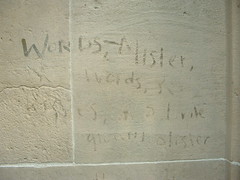
Words


EnglandFrance 006
Originally uploaded by True North Two
I spotted this piece of graffiti while visiting Oxford University in the summer of 2003. I can't make out what most of it says, but I remember that it caught my eye because the word "Mister" looked like "Aleister" at first glance and I had just visited an Occult book store.

Thursday, July 31, 2008

A Faithful Friend


From Forgotten Ohio:

"This is the grave of Johnny Morehouse and--according to legend--his dog, a pair who are Woodland's most famous ghostly residents. The story might be rooted in nothing more than an unusual tombstone, but this is what they say: Johnny fell into the Miami & Erie canal and froze to death, despite his faithful dog's efforts to pull him out. After he was buried, the dog laid on his gravesite and wouldn't be moved. Eventually it died from starvation and sadness. A special stone was made in 1861 to commemorate Johnny's dog's devotion. People leave toys, candy, and other trinkets on the stone--a ritual the cemetery management tolerates, as you can tell from the photo above."

I've visited this stone twice now (once in the winter when the cemetery was covered in snow and again the following summer). Both times, the monument was decorated with small trinkets and flowers. Someone even tied a bandanna on the dog's neck.

Symbols like this monument are important to perpetuating local legends. I suspect there is some truth to the story, though the Victorian penchant for all things dramatic makes it very likely that there was strong elaboration involved somewhere along the line.

I find it interesting the way in which physical objects with sketchy histories spawn stories that are passed down through the generations. It seems like every small town has a cry baby bridge, haunted cemetery or Satanic church. A creepy old building, a dangerous intersection, or even an abandoned playground likely has a story attached. The fun part is finding the kernel of truth behind the symbol.

If you would like to visit Johnny and his faithful dog, head to Dayton's Woodland Cemetery.
Sadly, the dog's head was recently cut off and stolen. A photo of the damage can be found on the Forgotten Ohio site.